
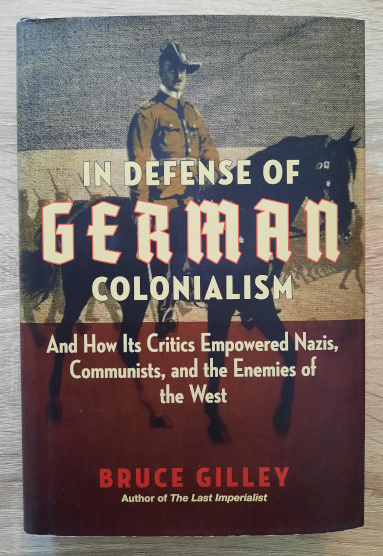
In Defense of German Colonialism - Bruce Gilley
- Author
- Bruce Gilley, PhD
- Title
- In Defense of German Colonialism
- Edition
- Regnery Gateway 2022, 304 pages
- Language
- English
The title of this book, as well as its subtitle “And How Its Critics Empowered Nazis, Communists, and the Enemies of the West” may sound very provocative to many people. Scandalous even.
Every child “knows” that colonialism - and especially German colonialism - was a horrible crime against humanity, after all; a system based on injustice and violence in order to oppress, enslave and exploit weaker peoples, a system steeped in racism and not uncommonly leading to genocide against the natives. Thus the general view, which is supported by the seemingly unanimous and irrefutable verdict of historical and postcolonial scholarship in the universities.
However, scholarship and science deserving of their names are not characterized by unanimously proclaiming indisputable dogmas and eternal truths, but by striving to gain knowledge. This makes regular reevaluation of taken-for-granted scientific consensus indispensable.
If facts allow for different interpretation, then even controversial theses, which contradict the generally accepted view, should - indeed have to - be formulated and included into the scientific discourse. This is exactly what Dr. Bruce Gilley does in the book at hand.
Author und origins of the book
Dr. Bruce Gilley, a Canadian-American economist and political scientist and professor of political science at Portland State University, is no stranger to both the topic of colonialism as well as to causing controversy. Gilley lived in Hong Kong from 1992 to 2002 and during that period of time he witnessed the transfer of the British colony Hong Kong to the People’s Republic of China.
Surprised by the attitude of the locals, who harbored pronounced pro-British views and felt more anxious than joyful about their “liberation”, Gilley decided to research the topic of colonialism.
In 2017, he published the results of his research in the article The Case for Colonialism, which, based on its overall positive verdict on colonialism, promptly caused an outrage in the scientific community and the media and led to death threats against the author (the article has been reworked into a book in the meantime, published in 2023 under the same title).
Undeterred, yet again astonished by the fact that British sources from the First World War remark about the exceptional loyalty of the native Africans to their German colonial masters, Gilley focused on researching German colonialism specifically. This book presents his findings.
Published first in German under the title Verteidigung des deutschen Kolonialismus by Manuscriptum Verlagsbuchhandlung in 2021 (on his YouTube channel, Dr. Gilley offers an English-language introduction video about this edition, accompanied by historical photographs), my review concerns the English edition which was published one year later. According to the author, this edition has been significantly expanded by the results of new research as well as feedback on the German edition, especially in regard to the consequences of the loss of the German colonies for Germany and Europe and about the ideologies and activities of anti-colonialists of all shades.
Theses and insights
“Colonialism was the true ’liberation struggle’.” ~ p. 80
The political and ideological beliefs of the author provide the basis of his assessment of colonialism: Gilley, a staunch advocate of “the West”, is passionate about the values he believes in: Enlightenment, human rights, democracy, the rule of law, and free market economy.
Gilley does not perceive these values to be in conflict with colonialism - on the contrary, he believes them to be at its very core: in his view, not racism, oppression and economic exploitation, but cosmopolitan, humanistic and progressive motives in the spirit of classical liberalism characterize colonialism.
1.) Theory and practice of German colonialism
The German Empire took a leading position in consolidating and implementing an understanding and practice of colonialism that was based on civilizational, classical liberal, and enlightened values. According to Gilley, a conference of all colonial powers in Berlin, organized by the German Empire in 1885, proved to be of outstanding importance for German colonialism as well as European colonialism as a whole.
At this conference, the German Empire, a late- and newcomer among the colonial powers with little colonial possessions yet, acted as “honest broker” and suggested that all colonial powers adhere to a voluntary self-commitment:
- The “moral and material wellbeing of the indigenous population” (p. 31) has to be actively increased, slavery has to be abolished, religion, science and charity have to be promoted.
- Institutions of government, administration and justice have to be established in the colonies in order to justify and maintain a colonial claim, instead of basing it solely on the presence of settlers or even only the economic exploitation of natural resources by trading companies.
Gilley is aware that paper doesn’t blush. However, he percieves a sincere intention behind this self-commitment, to which the colonial powers subsequently indeed felt bound:
“Words only. But words that would create norms, and norms that would shape behavior.” ~ p. 31
And the reality of the German colonies (seven in number and covering the territories of several present-day African and Oceanic states, as well as the northern part of Papua New Guinea and an area in China around the city of Qingdao) is proof of that, according to Gilley.
A common pattern emerges: nothing could be further from the truth than a peaceful and blissful life before the arrival of the “oppressors”. On the contrary, in each case pre-colonial existence meant a life in poverty and misery, with regular outbreaks of epidemics and famines. On top of that, the future colonial territories in Africa and Oceania were plagued by neverending blood feuds, wars, raids and violent enslavement of the tribes among each other.
In addition to establishing and maintaining peace, the German colonial rule brought the abolishment of slavery as well as manifold opportunities for social and economic advancement for the locals. Furthermore legal security and the rule of law were established, same as infrustructure, modern medicine and education. Developments that all were enthusiastically welcomed and utilized by the overwhelming majority of the natives.
Revolts against German colonial rule, like for example the Herero uprising in German South West Africa or the Maji-Maji Rebellion in German East African, can in no way be classified as “liberation movements”; instead their origin and motivations can be traced to the resentment of disempowered former elites, seeking the restoration of slavery as well as the ethnic cleansing of the country from the colonial masters and their allied tribes. The acts of the insurgents were accordingly marked by great brutality.
The violent suppression of the revolts by the Germans and their native auxiliaries was therefore a necessary and inevitable reaction, according to Gilley, and furthermore was not based on genocidal plans but the aim of protecting peace, liberty and life of the majority of the population in the respective colony.
The author also details how military excesses as well as crimes of government officials, settlers and companies against the indigenous population reliably led to a public outcry of disgust and indignation in the German Empire and unleashed political investigation committees, legal convictions and social condemnation upon the delinquents.
Equally impressive are the examples of how German scholars and scientists threw themselves into linguistic, botanical, geographical, historical and cultural research about the conlonies - and decidedly not just for consolidating colonial power but out of genuine enthusiasm and fascination for the foreign peoples in the colonies, for their cultures and homelands.
In German East Africa, for example, the Germans enacted measures for the protection of nature and the local wildlife, like outlawing the hunting of elephants or establishing natural and wildlife reserves that would be continued by the British after their takeover of the German colonies (one example would be the Serengeti National Park). The Germans also strengthened local languages, like Swahili, and promoted the teaching of native languages in schools as well as the publication of newspapers in the local dialects.
Gilley quotes statements of the German governors of several colonies that illustrate how they viewed acceptance, support and voluntary cooperation of the natives as essential for the colonial project and its success (for example, a German governor prohibited Christian missionary work in the predominately Muslim area of Northern Cameroon) and express genuine respect for the indigenous people and their culture:
“[T]hey are far from being foolish, primitive, ridiculous savages over which the European is mighty and sublime. They have their idiosyncracies, like us, like all people have them. But let us be careful not to apply our own standards of civilization to other peoples which we do not understand!” ~ Albert Hahl, governor of German New Guinea, p. 141
The European and especially the German colonial rule always brought a drastic improvement of the living conditions of the natives. Accordingly and as a riposte to definitions of colonialism that stress the oppression of the indigenous people, Gilley suggests the following definition of colonialism with a focus on the natives:
“Colonialism is a relationship marked by shared governance and liberation from native domination in which the colonized are given unprecedented opportunities to develop the capacities and practices of self-determination, are subject as equals to laws and rules that provide a degree of self-organization and autonomy unprecedented in their histories, and for the first time are able to articulate as equals the needs and interests of their communities, especially as far as politics and economic aspects are concerend.” ~ p. 250
2.) Historical and ideological origins of anti-colonialism
In contrast to that stands the record of the former colonies since their independence, and especially the record of “liberation movements” which were cheered upon and supported by the enemies of colonialism and which, in most cases, led to bloody dictatorships, ethnic violence, economic collapse and/or incessant civil wars and famines.
“What is the point of decolonization if it makes people worse off” ~ p. 243
To Gilley, this is no coincidence and he demonstrates that the earliest and fiercest critics of colonialism were all to be found within the radical left or right.
But first he points out that the prevailing image of the Germans as outstandingly brutal colonial butchers and unscrupulous oppressors only came into being after the First World War and was mainly painted by Great Britain.
While precisely the British were very open in their admiration for the efficiency, humaneness and the accomplishments in the German colonies before the Great War, the outbreak of hostilities was then seen as a chance to grab the German colonies. The slanderous and knowingly false propaganda of “German barbarism” in the colonies was of course intended to serve as a preparation and justification for the planned annexation of the German colonies.
But together with the colonies, the post-war Germany of the Weimar Republic lost her former self-image, which was at the foundation of the colonial project and widely accepted in society and politics: the cosmopolitan, humanistic and classical liberal self-image of being a part of a civilizational mission that was pan-European and indeed encompassing all of humanity.
This in turn opened the doors for the extremists of the political left and right to campaign against precisely those classical liberal and European values, to present them as hypocritical, corrupt, and oppressive and to lay the ground for an illiberal, anti-civilizational sentiment.
Gilley reveals that both the ultranationalist predecessors of National Socialism as well as its leading figures held fiercely anti-colonial convictions. In their view, colonialism was a gigantic waste of ressources and energies that could have been put to use far more productively for a war of conquest followed by settlement in Europe herself.
The German people scattered accross all continents and on top of that constantly faced with the temptation of racial mixing, was not in the interests of Völkisch nationalism. In the Third Reich, the colonial lobby was largely silenced and her leading proponents were made to understand that colonies outside of a policy of conquest in Eastern Europe were undesirable.
“The Nazis […] represented everything that German colonialism was not: illiberal, anti-capitalist, and suspicious of racial mixing.” ~ p. 194
After Second World War, the Soviet Union and alongside it the German Democratic Republic (GDR, “East Germany”) became the leading forces in anti-colonial propaganda. Unsurprisingly, historical scholarship in the GDR was not interested in objective, factual historiography but understood the science of history as a tool in service of Marxist-Leninist ideology.
The condemnation of historic German and contemporary West European colonialism was therefore treated as a duty and was pursued as “advertisement” for communism as the ideology of liberation and of the united struggle against the capitalist West.
Gilley shows how the GDR’s particularly radical anti-colonialist “research findings” about German colonialism were met with great approval and admiration even in Western universities, where they were picked up with great enthusiasm now and then by left-leaning professors. Meanwhile, contradictory, interfering facts, as well as the bloody effects of leftist theory in practice were completely blocked out and ignored.
3.) Contemporary anti-colonialism as totalitarian attack on “Western values”
“The GDR clearly won the Cold War as far as German scholarship on colonialism is concerned.” ~ p. 245
Contemporary “Woke” culture warriors appear to Gilley as the direct heirs of the totalitarian movements of the 20th century. He regards both the aforementioned historical movements as well as contemporary ideologues and activists of anti-colonialism and postcolonialism as convinced mortal enemies of “the West”, as illiberal, anti-enlightenment fanatics, who strive for a “great leap backwards in human progress” (p. 4) and who fundamentally reject the Western achievements, values and way of life as inherently racist and/or degenerated and exploitative.
According to Gilley, their incessant attacks against Europe’s and especially against Germany’s colonial history should always be seen in the context of an attack on Western civilization, values and way of life itself.
These attacks are directed with a special viciousness against Germany, which is not only the geographical, but also the historical, cultural, scientific and economic “heart of Europe”. Yet their intended targets are Europe and “the West” as a whole.
Their goal is nothing else than the complete destruction of the detested “West” and the establishment of totalitarian, anti-capitalist and anti-semitic dictatorships, which are blatantly celebrated and glorified by the fiercest enemies of colonialism.
The author holds that anti- and postcolonial mainstream scholarship has nothing to do with objective, facts-based science, but instead is based on ideological grounds - and self-admittedly so - and seeks to promote contemporary “progressive” politics.
Its openly self-declared goal is not gaining historical knowledge and establishing truth, but justifying and enforcing political measures in all areas, like “immigration, foreign aid, trade policies, climate change, defense policy, global public health, public education, political systems, and global governance” (p. 261).
It is the declared goal of Gilley’s study to expose that these political demands and activities are rooted in totalitarian ideologies and conscious historical falsehoods and distortions, and that they are paving the way into disaster and misery, for “the West” and for the developing countries equally. He wants to oppose this danger with facts which paint a completely different picture of German colonialism and therefore of Germany and “the West”.
Accordingly, Gilley does not view the engagement with the history of (German) colonialism as a useless, out of touch debate within the academic ivory tower, but as a contribution to the defense of the Western values and way of life that is absolutely crucial and essential for survival.
Writing style and critical remarks
“[E]ducated people in free societies have a troubling tendency […] to reject the dogma […] Perhaps a few more didactic art installations would do the job! Something about the ‘imperial gaze’ of aerial filming techniques perhaps.” ~ p. 227
The book reads smoothly, is entertaining and never gets boring. This is not only due to Gilley’s style of writing, who is able to depict the successes, crises and the drama of his research object in a powerful way and on top of that displays a marked inclination towards ridicule, irony, and sarcasm when he goes to battle against anti-colonialist ideologues and postcolonial myths.
However, it has to be said that this mocking tone sometimes gets a bit out of hand and appears to be more sneering, venomous, and scornful than humorous. You have to like that. On the one hand, it is quite understandable that there is an urge to retaliate with full force against some particularly scatterbrained theses, absurd statements and brazen lies. Even more so when you think of yourself as being on the side of truth and in the middle of an important political contest for the future of humanity itself, like Gilley self-admittedly does.
On the other hand, this is not necessarily doing any favors to giving the impression of seriousness and sovereignty in a debate. However, this is a matter of taste and opinion and quite a few readers will probably think of Gilley’s way of pitting himself against his opponents as very refreshing and entertaining.
As already mentioned, he certainly knows how to write in an entertaining way and he is very good at exposing the sometimes abysmal absurdity of the theses of some leading post-colonial scholars. For example, when a Marxist professor thinks she unveiled the “diabolical plan” of some German governors to raise the natives from poverty to the level of the wealthy property-owning bourgeoisie, in order to prevent the emergence of revolutionary thoughts and thus the realization of the communist utopia (p. 143).
Impressive and a clear confirmation of Gilley’s point of view are also several of his examples, where the postcolonial mainstream in the universities and the media reveal themselves to be wholly ideologically motivated and where they openly declare, that certain topics can not be “up for debate” but must remain “beyond dispute” (e.g. Preface p. ix) and that scholars and amateurs who come to positive conclusions about colonialism should please always ask themselves what sinister political forces they are providing arguments for - mind you, without denying or refuting the pro-colonial scientific findings.
In some places, however, the opposite impression arises that Gilley, in his “righteous zeal” and politically motivated defense of colonialism in the culture wars, goes a bit too far.
For example, it is questionable whether the European public, the government, administration and judiciary at home and in the colonies indeed had a point of view and approach towards the colonial peoples that was so strongly marked by the ideals of Enlightenment and humanism. Existing source material from this period does indeed allow for quite different conclusions as well.
It also appears as a bit unpleasant when people like Carl/Karl Peters, who was highly controversial even among his contemporaries because of his propensity for violence and deeply chauvinistic personality, are dismissed with the argument that their statements and actions can be explained with youthful exuberance and that their contemporary and later condemnation is mainly due to anti-colonial profile-seeking behavior.
Similarly, Gilley’s insistence on the noble values of the 1885 conference of the colonial powers in Berlin as the driving force behind the colonial projects invites comparison with contemporary cases, where the “value-based West”, with the USA in the role of the leading offender, initiates massive bombing campaigns, military interventions and invasions as well as instigating regime changes and coups d’ètat which result in decades of bloody chaos - and all of that while officially citing moral reasons for these actions, like the establishment or promotion of democracy, human rights and freedom in the respective states.
Final verdict
I highly recommend this book to anyone interested in history and, in general, to anyone who thinks critically and who has an interest in objective historiography and the search for truth. Like already mentioned, you will have to overlook a few passages that are overly eager in their defense of colonialism and it goes without saying that, as always and everywhere, we should critically reflect upon what we read.
It should be clear to every rational person that numerous prevailing interpretations of history today, as well as at all times and in all ages, serve to legitimize the hegemony and enforcement of political and social goals, and not to find objective truth.
It should be equally clear that a phenomenon such as colonialism cannot be viewed exclusively in terms of black and white. An objective assessment cannot ignore the fact that, next to obvious injustice, violence and exploitation, colonialism also brought positive, beneficial aspects to the lives of the colonized peoples and that colonialism, in ideology and practice, significally differs from genocidal plans of colonization like those of the National Socialists in regards to Eastern Europe.
Dr. Bruce Gilley, with this book, offers an important contribution to this realization, to the search for historical truth and to a more just and balanced assessment of the history of colonialism, Europe and Germany.
One might take issue with Gilley’s rosy view of “the West”, classical liberalism and capitalism and disagree with some of the conclusions of his study. However, none of this detracts from his merit.
His study is an urgently needed corrective, based on verifiable facts, to an extremely one-sided, politically and ideologically motivated distortion of historical scholarship with a highly destructive agenda.
For this, as well as for his personal commitment and great courage to take a stand against the prevailing, politically desired and socially dominant opinion and to accept the resulting repercussions and disadvantages - for his career, his social standing and his personal safety - he deserves great respect and gratitude.
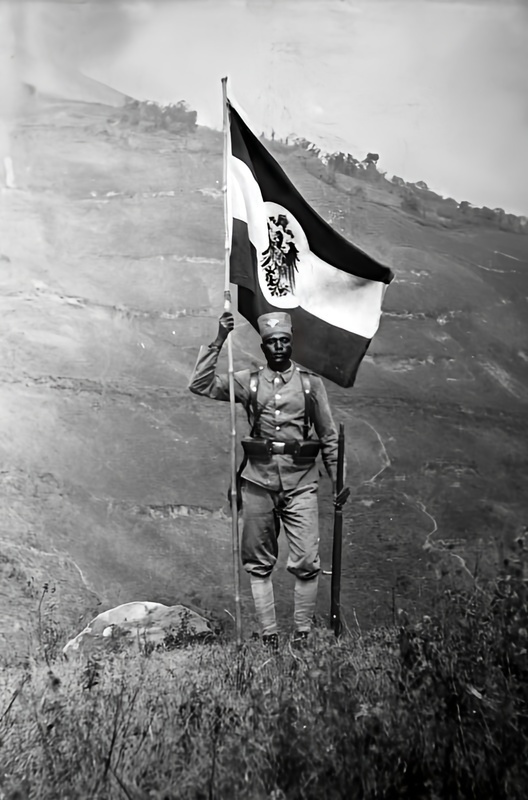
An African Askari soldier in German East Africa