
The Master of the Day of Judgment - Leo Perutz
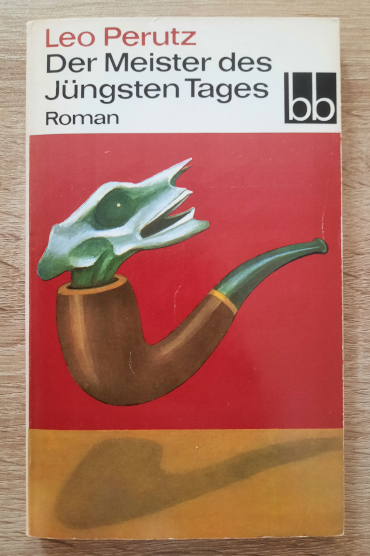
- Author
- Leo Perutz
- Title
- The Master of the Day of Judgment
- Edition
- Aufbau Verlag Berlin und Weimar 1984, 156 pages
- Language
- German
According to the publisher’s description, this novel is a connecting link between “the classic English crime novels” and the Swiss author Friedrich Dürrenmatt as well as reminiscent of the “horror stories of Nathaniel Hawthorne and Edgar Allan Poe”. And German Wikipedia tells us, that the Argentine master Jorge Luis Borges admired the novel so much that he included it in his list of the greatest crime novels of the 20th century.
My interest was certainly sparked.
The author, Leopold “Leo” Perutz (* 1882, † 1957), a Jew born in the Prague of the “Danubian Monarchy” Austria-Hungary, worked as a mathematician for an insurance company but also belonged to the Empire’s literary circles that frequented the cafés of Vienna. His works are considered to be part of the genre of magical realism, most of them are historical novels with pronounced supernatural elements.
He had already achieved first popular success with his German-language works in the years prior to the Great War. But his main creative period spanned the decade from 1918-1928. It was during this time, in the year 1923, that he created The Master of the Day of Judgment which was to become one of Perutz’s most successful books.
This review is based on the German original. The book has been translated into English, but all following excerpts and quotes in this review have been loosely translated by me.
The Plot
“A horrible sign of fire stands in the sky […] And it shines in a color which I have never seen before. Woe is me! This color is not of this earth and my eyes cannot bear it.” ~ p. 139 f.
The novel is set in the Vienna of the year 1909, its plot spans merely five days in late September and it is presented from the perspective of the Freiherr (i.e. Baron) von Yosch.
He recounts in private notes how he, together with some acquaintances, solved a series of mysterious suicides that happened a couple of years earlier, all of which involved artists.
There seem to be similarities between the cases: the suicides all took place in a state of extreme panic and without any discernible reason. Additionally, all victims were creatively inclined, had recently developed an interest in the Italian language and increasingly often returned home later than it was their usual habit.
Furthermore, the concept of the Day of Judgment is referenced repeatedly and a strange color called “drommet red” seems to play a role as well.
However, the investigations are not pursued out of selfless motives but for a very compelling reason: Yosch is accused of deliberately driving one of his acquaintances, an actor, into suicide in order to have free rein in courting the latter’s wife.
Because Yosch gave his word of honor as an officer of the army but the evidence stands against him, it seems inevitable for him to commit suicide too, unless he wants to face complete social disgrace and military demotion - or unless he can prove his innocence.
An antihero and unreliable narrator
“[S]ome sort of pride awakened within me and drove me to shake the confidence of the man who stood before me, to lead him astray and to cast him into doubts. I said in cold blood and with full deliberation: ‘‘And what if […] I confess to you now that I am indeed the murderer of Eugen Bischoff —?’’ " ~ p. 107
Gottfried Adalbert Freiherr von Yosch und Klettenfeld, captain of the cavalry and simply called “Yosch"or “baron” by most people in the story, is the protagonist and narrator of the novel.
The pipe-smoking Yosch exerts a powerful fascination not only on his friends and enemies but also on the reader alike. He is a charismatic antihero without any discernible positive personality traits.
Within the novel he is described by others several times as completely amoral and dangerous and is compared to a (predatory) cat that plays with its victims.
Beyond that, however, he also acts as a decidedly unreliable narrator.
In spite of his repeatedly demonstrated outstanding gift for observation and an excellent memory, he selectively presents himself as very inattentive and forgetful.
In those instances he is unable to recall important details or his own actions during a specific period of time or pretends to be oblivious of things that he himself described just a few pages ago.
Sometimes, driven into a corner by all too obvious contradictions or objections by others, he has to admit to his true motives or “spontaneously” remembers the true course of events, “surprised” about his “mistake”.
He is subject to strong sensations and sometimes tricks of the senses, which he experiences in great detail and vividly. Therefore it is not always clear which of his various conclusions and observations are real.
It is also striking that Yosch indeed takes on the role of only a passive observer and narrator during large parts of the story, even though nothing less than his own life is at stake. He often just accompanies his acquaintances and leaves all the talking and acting to them (a fact which is even remarked upon by them).
Themes and motifs
“To sleep from one night to the next, to sleep without dreaming, to cheat the devil out of a gray autumn day, to break the tyranny of the hours with a slight motion of the hand —” ~ p. 120
A consistent theme is mourning over times that are irrevocably gone. Both Yosch and other characters are caught in old memories and are unable to let go of the past.
The memories are often connected to a torturous, persistent sense of guilt over irreversible decisions and deeds from the past. The sufferers try in vain to escape these feelings by running away from them or attempting to suppress them.
Deception pervades the narrative, both self-deception and deception of others in regard to identities, motives, intentions, actions and presence or whereabouts.
A recurring motif are disfigured faces, be it because of extreme emotions, illness, death or simply by not matching the rest of the appearance.
And last but not least the issue of suicide is constantly present: in the cases under investigation, as the looming fate of Yosch, or in the memories and narratives of other characters.
The atmosphere
“Out of town, indeed. Abroad. Much farther than abroad, dear sir. If I were to travel day and night for ten years straight, I still would not be able to reach him.” ~ p. 129
While the city of Vienna is interchangeable for the plot, the season is indeed of significance: it is autumn and chestnut leaves, early darkness, cold winds and heavy showers of rain are constant companions throughout the story.
This contributes to an overall oppressive mood. There is an atmosphere of finality, closure and death.
A sense of urgency, compulsion, and lurking demonic doom is ever-present in the plot.
Due to Yosch’s unreliable narrative style much remains ambiguous, only hinted at, implicit and open for interpretation by the reader.
A scene that is completely incidental to the plot yet interesting may serve as an example: in the face of a portrait of an actress who had also died by suicide long ago, Yosch muses on how her beauty had enchanted and incited him in his youth.
Meanwhile, the aged father of the deceased woman laments the events of over twenty years ago, the broken marriage of his daughter and her suicide “because of some good-for-nothing lieutenant”. As they leave, a companion of Yosch mocks him and asks if he failed to notice that the old man is completely blind and was not even aware of the presence of the silent baron. Why, then, did he perform that strange bow in front of the blind man when they left?
Final verdict
“Know, […] that things that have been done never end and may he who did them be prepared to face God’s justice.” ~ p. 136
The short novel provides an exceptionally smooth and gripping reading experience. From the very beginning the strange, ominous mood, the enigmatic, ambiguous events, and the peculiar protagonist and narrator capture the reader.
The novel defies clear genre boundaries: crime fiction, supernatural horror, thriller, surreal literature, psychological novel - all of these are accurate and the emphasis depends on the reader’s interpretation.
Perutz is a master both in creating ambivalence and mystery as well as in using concise and precise language in order to conjure an impressive atmosphere and detailed pictures, both when describing the external world and the internal world of his characters.
Not only the personality of Yosch is skillfully painted: Perutz also excels at endowing most characters of the story with a distinctive personality with psychological depth, once again by using only a few words. This is true even for minor characters who only make brief appearances or even do not appear at all in person but are only present in the accounts of others.
During the course of the novel, the mood, narrator, and themes reminded me more than once of the classic short story The King in Yellow by Robert W. Chambers. The supernatural, disturbing and outlandish element is more pronounced with Chambers, Perutz’s narrative is less surreal, yet similarities can be perceived, even though it is unlikely that the two authors knew of each other.
In any case, my conclusion is: anybody who appreciates suspenseful, well thought-out and truly superbly written literature can pick up this book without second thought.
I thoroughly enjoyed the reading experience! The Master of the Day of Judgment was the first book by Leo Perutz that I have read - but it will certainly not be the last.